

Le volant que vous tenez entre les mains vous ment probablement, masquant jusqu'à 45 % des données télémétriques critiques que vos pneus tentent de communiquer. Lorsque vous atteignez l'apex à Spa, vous ne devriez pas avoir à lutter contre un filtre mécanique composé de courroies et d'engrenages qui amortissent la physique brute de la voiture. Le passage à un système de transmission directe est le seul moyen d'éliminer cet obstacle. Vous avez déjà ressenti ce moment frustrant où le retour de force se transforme en un désordre boueux et vibrant à cause de l'écrêtage mécanique. C'est la principale raison pour laquelle les pilotes de simulation perdent l'arrière de leur véhicule : le matériel n'est tout simplement pas assez rapide pour relayer la perte de traction avant qu'il ne soit trop tard.
Pour obtenir une fidélité de pilotage à l'échelle 1:1, il faut une connexion sans compromis avec le macadam, que seul un matériel de qualité professionnelle peut offrir. Ce guide 2026 vous aidera à maîtriser les nuances techniques telles que les vitesses de pivotement et les valeurs Newton Meter, afin que vous puissiez choisir un empattement qui comble le fossé avec la réalité du sport automobile. Nous examinerons le dernier matériel d'élite pour vous aider à construire un écosystème de course à l'épreuve du temps qui vous permettra de gagner des dixièmes sur vos temps au tour. Vous allez découvrir comment éliminer le décalage entre le monde virtuel et le bout de vos doigts pour un contrôle total de votre voiture.
Principaux enseignements
- Comprenez comment l'élimination des filtres mécaniques grâce à une architecture directe entre le moteur et l'arbre crée la connexion la plus authentique avec la piste numérique.
- Décodez les nuances techniques du couple maximal et de la résolution de l'encodeur pour sélectionner un moteur qui offre une douceur et une précision de haut niveau.
- Apprenez à aligner votre choix de matériel avec votre discipline de course spécifique en utilisant un logiciel de réglage avancé pour une sensation personnalisée et professionnelle.
- Maîtrisez la règle de la "rigidité d'abord" pour vous assurer que votre cockpit est conçu pour supporter les forces sans compromis d'un empattement à entraînement direct de haute performance.
- Découvrez comment construire un écosystème professionnel homogène en intégrant des composants de qualité supérieure provenant de marques de premier plan telles que Simucube et Simagic.
Qu'est-ce que le Direct Drive et pourquoi définit-il le Sim Racing moderne ?
L'entraînement direct est l'apogée du matériel de simulation de course. Il représente un changement fondamental dans la manière dont le retour de force atteint vos mains. Dans un volant de simulation de course à entraînement direct, la couronne de direction est montée directement sur l'arbre d'entraînement du moteur. Il n'y a pas de pièces intermédiaires. Pas de poulies. Pas de dents en plastique. D'ici à janvier 2026, cette technologie sera passée d'un luxe élitiste à une exigence de base pour tout poste de pilotage sérieux. Les unités d'entrée de gamme fournissent aujourd'hui un couple de 5 à 8 Nm pour moins de 300 dollars, ce qui rend les anciennes technologies à engrenages obsolètes pour la compétition.
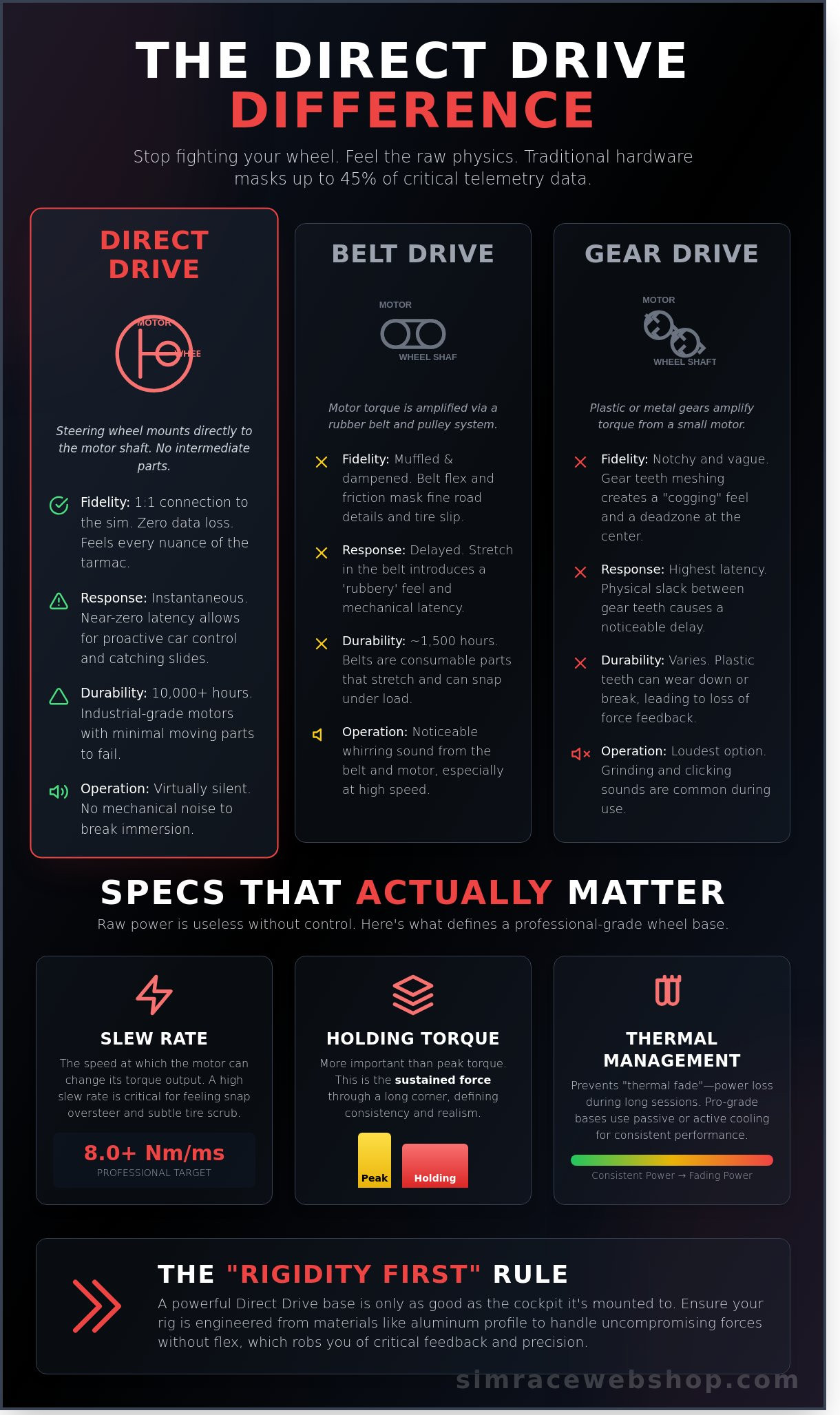
Les systèmes plus anciens agissent comme un filtre mécanique. Ils utilisent des courroies ou des engrenages pour amplifier le couple de petits moteurs à grande vitesse. Ce processus introduit des frottements et des amortissements qui masquent les détails de la surface de la route. Cette technologie élimine totalement cet obstacle. Vous recevez instantanément le résultat brut du moteur physique. Il ne s'agit plus d'un simple périphérique de jeu, mais d'un outil d'entraînement de niveau sport automobile utilisé par les pilotes professionnels pour conserver leur avance. La transition est achevée. En 2026, le système d'entraînement direct est au cœur de tous les dispositifs de haute performance, des installations domestiques aux simulateurs d'équipes professionnelles.
Entraînement direct et systèmes d'entraînement par courroie et par engrenage
Les roues à engrenages reposent sur l'engrènement de dents physiques. Cela crée une sensation d'encoche et une zone morte perceptible au centre de l'arc de direction. Les systèmes à entraînement par courroie améliorent la situation mais introduisent une sensation d'étouffement car les courroies en caoutchouc s'étirent et fléchissent sous l'effet de la charge. Cette technologie élimine ces problèmes en supprimant l'intermédiaire. L'absence de frottement interne des courroies ou des engrenages réduit la latence mécanique à un niveau proche de zéro milliseconde. La durabilité est un autre facteur important. Un moteur comporte moins de pièces mobiles susceptibles de s'user. Alors qu'une courroie peut se rompre après 1 500 heures d'utilisation intensive, un moteur industriel de haute qualité dans une base moderne est conçu pour durer plus de 10 000 heures de sessions actives.
Les avantages fondamentaux : Fidélité, détail et cohérence
La précision fait la différence entre un podium et une défaite. Ce matériel vous permet de sentir la limite d'adhérence à travers la crémaillère de direction avant que la voiture n'ait réellement perdu l'adhérence. Vous pouvez sentir que les pneus avant frottent ou que les pneus arrière commencent à tourner grâce aux vibrations subtiles du moteur. Ce retour d'information haute-fidélité permet de développer une mémoire musculaire supérieure. Un rapport de direction de 1:1 garantit que 10 degrés de rotation physique correspondent toujours à 10 degrés de mouvement virtuel de la crémaillère, sans le flottement que l'on trouve dans les équipements grand public. Il crée un lien psychologique avec le monde réel. Vous arrêtez de jouer à un jeu et commencez à conduire une voiture. L'immersion est absolue car les forces que vous ressentez correspondent aux données télémétriques d'un véritable châssis de GT3 ou de Formule.
- Réponse instantanée : Aucune latence entre la physique de la simulation et vos mains.
- Couple de pointe : Niveaux de puissance soutenus allant de 5Nm à 30Nm pour une direction lourde réaliste.
- Fonctionnement silencieux : Pas de grincement d'engrenages ou de courroies pendant les manœuvres intenses.
- Étalonnage professionnel : Le logiciel avancé permet un réglage granulaire de l'amortissement, de la friction et de l'inertie.
Les caractéristiques techniques qui comptent vraiment : Au-delà du nombre de Nm
La puissance brute est inutile sans contrôle. Alors que la plupart des documents marketing présentent un seul chiffre de couple, l'élite des simulateurs de course s'intéresse de plus près à la manière dont cette puissance est délivrée. Le couple maximal représente la poussée maximale qu'un moteur peut produire pendant une fraction de seconde, souvent lors d'un impact soudain ou d'un coup de trottoir. Le couple de maintien est la mesure la plus critique. Il définit la force soutenue qu'un moteur conserve dans un long virage à grande vitesse, comme le Parabolica de Monza. Un système d'entraînement direct qui affiche un couple de pointe de 20 Nm, mais qui tombe à 12 Nm sous charge soutenue, donnera une impression d'incohérence et d'imprévisibilité lorsque vous chercherez à atteindre l'apex.
La vitesse de balayage est le héros méconnu de la fiche technique. Mesurée en Newton-mètre par milliseconde (Nm/ms), cette valeur détermine la vitesse à laquelle le moteur modifie son couple de sortie. Une vitesse de balayage élevée, généralement de 8,0 Nm/ms ou plus dans les appareils professionnels, garantit que les forces que vous ressentez dans la jante sont instantanées. Si la vitesse de pivotement est trop faible, le retour d'information est "caoutchouteux" ou retardé, ce qui rend impossible la capture d'un moment de survirage à 200 km/h. C'est cette rapidité de réponse qui crée le lien physique entre les pneus virtuels et vos mains.
La gestion thermique distingue les outils professionnels des jouets grand public. Les moteurs à haute performance génèrent une chaleur importante au cours d'une utilisation de 90 minutes. Si une base n'est pas suffisamment refroidie, la logique interne réduira la puissance pour protéger les composants, un phénomène connu sous le nom d'évanouissement thermique. Recherchez des bases utilisant des boîtiers en aluminium de haute qualité qui agissent comme des puits de chaleur massifs. Certains modèles d'élite maintiennent un delta de température inférieur à 5 degrés Celsius, même après des heures d'utilisation intensive, ce qui garantit que votre retour d'information au dernier tour est identique au premier.
Newton mètres (Nm) : Quelle quantité de couple est suffisante ?
La gamme de 5 à 10 Nm est le point d'entrée actuel pour une simulation sérieuse. Une base de 8 Nm fournit suffisamment de détails pour les installations montées sur un bureau ou les appareils d'entrée de gamme, sans nécessiter un cockpit en acier renforcé. En passant à la plage de 10 à 20 Nm, on entre dans le domaine professionnel. À 15 Nm, vous disposez d'une plage dynamique suffisante pour ressentir simultanément les transferts de poids subtils et les fortes compressions de la suspension. Les bases offrant 25 Nm et plus ne sont pas conçues pour être utilisées à 100 % de leur force. Au contraire, elles offrent une grande marge de manœuvre. Cela permet d'éviter l'écrêtage du signal, lorsque le moteur atteint sa limite physique et aplatit le retour d'information, perdant ainsi tous les détails pendant les manœuvres à fort coefficient de gravité.
Résolution du codeur et traitement du signal
La résolution du codeur définit la granularité de la sensation de direction. Les bases modernes haut de gamme utilisent des encodeurs de 22 ou 26 bits, fournissant des millions de points de détection discrets pour chaque révolution. Ce niveau de précision est courant dans les applications haptiques de haute précision telles que la chirurgie robotique, où il n'est pas envisageable de manquer un seul micron de mouvement. Dans votre cockpit, cette haute résolution élimine le "grain" ressenti dans les anciens systèmes à entraînement par courroie, ce qui se traduit par une rotation douce comme du beurre qui imite une véritable colonne de direction.
Le processeur, ou unité de traitement des signaux numériques (DSP), agit comme le cerveau de l'opération. Un DSP de 400 MHz peut calculer des données physiques complexes à partir de la simulation plus rapidement que le système nerveux humain ne peut réagir. Cette vitesse permet un filtrage avancé qui élimine les vibrations indésirables tout en amplifiant la télémétrie qui vous aide à conduire plus vite. Que vous choisissiez une connexion filaire pour une fiabilité maximale ou un système sans fil à faible latence pour les données du volant, l'objectif reste le même : l'immersion totale. Si vous êtes prêt à améliorer votre cockpit, vous pouvez explorer notre gamme de matériel à entraînement direct pour trouver la solution idéale à votre style de course.
Choisir la bonne base de transmission directe pour votre style de course
La précision est essentielle sur la grille. Le choix d'une base à entraînement direct ne se limite pas à la recherche du couple le plus élevé ; il s'agit aussi d'adapter les caractéristiques du moteur à votre discipline de course principale. Les pilotes de Formule et de GT3 ont besoin d'un moteur avec une vitesse de rotation élevée, dépassant souvent 6,0 Nm/ms, pour communiquer les changements rapides de frottement des pneus et de charge aérodynamique. En revanche, les amateurs de drift et de rallye privilégient une base présentant un faible frottement interne et des vitesses de rotation élevées. Ils ont besoin que la roue se centre d'elle-même et tourne librement sans que les aimants internes du moteur ne créent une sensation de "crantage" lors des manœuvres agressives de contre-braquage.
Les écosystèmes logiciels font le lien entre le matériel brut et les sensations sur la piste. Les bases haut de gamme offrent désormais un contrôle granulaire de l'amortissement, de la friction et de l'inertie. Le logiciel TrueDrive de Simucube reste la norme de l'industrie pour sa capacité à filtrer le "bruit" numérique tout en préservant la clarté tactile. Le logiciel Simpro Manager de Simagic a comblé l'écart en offrant une interface plus intuitive qui permet des ajustements à la volée. Vous n'achetez pas seulement un moteur, vous investissez dans une suite de réglages numériques qui détermine comment le transfert de poids de la voiture se fait à la limite.
L'achat d'une marge de manœuvre est une décision financière stratégique. Si une base de 10 Nm peut sembler suffisante aujourd'hui, elle oblige souvent le moteur à fonctionner à 90 % de sa capacité dans les virages à grande vitesse. Cela conduit à un écrêtage du signal, où les vibrations subtiles d'un trottoir sont perdues parce que le moteur est déjà au maximum de ses capacités. En passant à une unité de 15 ou 20 Nm, vous pouvez faire fonctionner la base à 60 % de sa puissance. Cela permet d'obtenir un tampon massif pour les forces maximales, garantissant que chaque détail reste net et que le matériel reste froid pendant les efforts d'endurance de 24 heures.
La révolution du milieu de gamme : Simagic et Moza
Le marché a évolué de manière significative en 2024 lorsque Simagic et Moza ont perturbé le monopole du haut de gamme. Le Simagic Alpha, doté d'un couple de 15 Nm, est devenu le choix de prédilection des coureurs intermédiaires qui exigent un retour d'information professionnel sans avoir à payer le prix à quatre chiffres des marques européennes. La série R de Moza a suivi, offrant un point d'entrée simplifié dans l'écosystème. Pour ceux qui construisent un cockpit à partir de zéro, ces fabricants proposent des offres groupées qui permettent aux coureurs d'économiser 12 à 15 % par rapport à l'achat séparé d'une base, d'une roue et d'un pédalier. Cette catégorie offre le meilleur rapport coût/performance, offrant 90 % de l'expérience de l'élite pour une fraction de l'investissement. Même les critiques grand public ont noté cette évolution, comme le montre l'article d'IGN sur le Logitech G Pro, qui souligne que même les géants du jeu sont désormais contraints de rivaliser avec ces marques spécialisées dans la simulation de course.
L'élite : Simucube et le matériel de qualité professionnelle
Lorsque la recherche du meilleur temps au tour devient une obsession, on passe à l'élite. Le Simucube 2 Pro, avec son couple de pointe de 25 Nm, est une référence en matière d'entraînement direct pour une fiabilité de niveau industriel. Il est conçu pour le prosommateur qui exige une flexion nulle et une intégrité absolue du signal. Ce niveau n'est pas seulement une question de puissance, c'est aussi une question d'intégration. L'écosystème Simucube comprend désormais la pédale active, qui utilise les données de télémétrie pour fournir un retour haptique directement via la pédale de frein. Cela crée un environnement unifié où la crémaillère de direction et le système de freinage communiquent en temps réel. Vous passez à ce matériel lorsque votre cohérence est limitée par votre équipement. Un équipement de qualité professionnelle fournit le retour d'information microscopique et reproductible nécessaire pour trouver le dernier dixième de seconde à l'apex.
Intégration : Préparer le poste de pilotage à la transmission directe
L'efficacité d'un empattement à transmission directe haut de gamme dépend de la structure qui le supporte. Considérez le moteur comme un moteur haute performance ; vous ne placeriez pas un V12 dans le cadre d'une voiture à hayon rouillée. Si votre surface de montage fléchit ne serait-ce que de deux millimètres, la fidélité à haute fréquence du retour d'information est absorbée par la structure au lieu d'atteindre vos mains. Cette règle de la "rigidité d'abord" fait la différence entre sentir un pneu frotter à la limite et ressentir une vague vibration amortie. Vous avez besoin d'une plateforme qui reste immobile pendant que le moteur travaille pour reproduire la physique de la piste.
Les solutions de montage définissent l'ergonomie spatiale et la pureté du signal. Les supports avant et latéraux sont la référence pour les installations d'élite car ils éliminent le besoin d'une plaque de support directement sous le moteur. Cela permet un dégagement maximal des genoux et un transfert plus direct du couple à travers les montants du châssis. Le montage par le bas reste courant pour les unités d'entrée de gamme, mais à mesure que vous progressez vers un couple de pointe de 20Nm ou 25Nm, les forces latérales peuvent entraîner le gauchissement ou le gémissement des plaques d'acier standard sous la charge. Des supports conçus avec précision garantissent que chaque bit de données télémétriques arrive au bout de vos doigts sans interférence.
Profilés en aluminium : Le seul vrai choix pour DD
Les cadres tubulaires standard ou les supports de roues pliables ne peuvent tout simplement pas supporter la force de freinage de 100 kg et le couple de rotation de Nm élevé typiques des installations modernes. Les profilés en aluminium à rainure en T, en particulier les modèles 80/20 utilisant des extrusions de 40 x 120 mm ou 40 x 160 mm, offrent la modularité et la rigidité requises pour un poste de pilotage sans compromis. Ces dispositifs permettent de boulonner le plateau de roue directement dans les montants verticaux robustes, faisant ainsi de la base un élément du châssis soumis à des contraintes. Découvrez nos cockpits en aluminium pour construire une base qui ne se déformera pas lorsque vous vous battrez pour la position à 200 mph.
L'importance de l'attache rapide (QR)
L'attache rapide est le maillon mécanique essentiel de votre écosystème d'entraînement direct. Un QR de mauvaise qualité introduit un "jeu mécanique", c'est-à-dire que les cannelures internes présentent de minuscules écarts. Même un problème de tolérance de 0,2 mm crée une zone morte qui ruine la connexion 1:1 avec la colonne de direction virtuelle. Bien que les déclencheurs de type D1 Spec soient populaires pour leur robustesse, de nombreux fabricants utilisent désormais des systèmes propriétaires sans jeu, tels que le Simucube SQR ou le support Invicta d'Asetek. Ces systèmes vous permettent de passer à chaud d'une jante GT3 à une roue de Formule en moins de cinq secondes sans vous soucier des axes qui se plient ou des signaux qui tombent au milieu de la course.
La gestion des forces physiques des bases à couple élevé est une question de sécurité autant que de performance. Les moteurs haut de gamme peuvent se bloquer avec suffisamment de force pour provoquer des blessures au poignet en cas de défaillance du logiciel ou d'accident grave. Installez toujours un bouton d'arrêt d'urgence (E-stop) à portée de main. Réglez votre position assise de manière à ce que vos coudes maintiennent un angle de 90 à 110 degrés ; vous aurez ainsi l'effet de levier nécessaire pour contrôler la roue lors de gros kickbacks, sans forcer sur vos épaules ou votre dos. La dernière étape consiste à gérer correctement les câbles, afin que les fils d'alimentation haute tension n'interfèrent pas avec les signaux de données USB et ne s'accrochent pas lors des manœuvres de direction rapides.
Prêt à éliminer la flexibilité de votre installation ? Découvrez nos solutions de cockpit de qualité professionnelle et sécurisez votre chemin vers le podium.
Construire votre écosystème ultime avec Sim Race Webshop
Le choix d'un empattement haut de gamme n'est que la première étape de votre voyage vers le podium. Chez Sim Race Webshop B.V., nous ne nous contentons pas de vendre du matériel, nous créons des environnements de haute performance. Notre catalogue 2026 se concentre sur les leaders de l'industrie : Simucube, Simagic et Moza Racing. Ces marques représentent le summum de la technologie d'entraînement direct, offrant le couple brut et la puissance de traitement des signaux nécessaires à une simulation de niveau professionnel. Nous donnons la priorité à l'expérience "Total Cockpit" parce qu'un empattement de 25Nm ne vaut que ce que vaut le châssis sur lequel il est boulonné. Si votre plate-forme fléchit, vous perdez des données télémétriques vitales à cause des vibrations mécaniques plutôt que de les ressentir dans vos mains.
Nous sommes passés de la vente individuelle au soutien de carrières de course à long terme. Cela signifie que nous considérons votre installation comme un organisme vivant. Lorsque vous investissez dans une base haut de gamme, vous entrez dans un écosystème où la compatibilité des micrologiciels et l'intégration des périphériques déterminent vos temps au tour. Notre équipe basée aux Pays-Bas fournit une assistance technique experte qui va au-delà du dépannage de base. Nous comprenons les nuances de l'écrêtage du signal et des profils d'amortissement. Grâce à notre centre logistique européen centralisé, nous maintenons un taux de stock de 98 %, ce qui garantit que 95 % des commandes passées dans l'UE arrivent chez vous dans les 48 à 72 heures. Vous n'avez pas besoin d'attendre des semaines pour gagner des dixièmes sur votre record personnel.
L'approche du consultant expert
Notre équipe traite chaque produit comme s'il était destiné à nos propres appareils. Nous testons chaque nouveau modèle à entraînement direct pendant au moins 40 heures pour vérifier la stabilité thermique et la linéarité du retour de force avant qu'il n'obtienne une place dans notre magasin. Ce processus de contrôle rigoureux garantit que la fidélité que vous ressentez au premier tour est la même que celle que vous ressentez lors d'une séance d'endurance de trois heures. Nous sommes spécialisés dans l'association de pédales et de roues pour créer un écosystème harmonieux. Pour 2026, nous avons élargi notre base de données de compatibilité afin de garantir que le mélange des marques n'entraîne pas de conflits logiciels. Nous nous engageons auprès de la communauté des simulateurs de course en organisant des webinaires techniques mensuels et en fournissant une assistance localisée qui parle votre langue, à la fois techniquement et littéralement.
Prêt pour l'Apex ?
Le passage à un équipement professionnel nécessite une stratégie calculée. Si vous passez d'un système à courroie à un autre, nous vous recommandons d'adopter une approche progressive. Tout d'abord, identifiez votre plafond de couple. La plupart des pilotes se situent entre 12 et 15 Nm pour une course soutenue, mais les professionnels optent souvent pour un couple de 20 Nm ou plus afin de capturer les détails à haute fréquence. Deuxièmement, tenez compte de votre interface physique. Les vêtements de course haute performance ne sont pas seulement esthétiques. L'utilisation de gants dédiés à la simulation de course peut réduire l'usure des volants en Alcantara jusqu'à 60 %, tout en assurant une meilleure adhérence lors des manœuvres à fort couple. Des bottes de course adéquates améliorent la modulation des pédales de 15 % par rapport à des chaussettes ou des chaussures de sport standard, ce qui vous permet de mieux contrôler le freinage par cellule de charge.
Votre évolution d'un joueur occasionnel à un pilote compétitif dépend de la fiabilité de vos outils. Nous fournissons le schéma directeur de cette transformation, en offrant le matériel et l'expertise nécessaires pour vous permettre de rester en tête de la grille. Il est temps d'arrêter de vous battre contre votre équipement et de commencer à vous battre pour la tête.
Passez à l'étape suivante de votre parcours de simulation : Découvrez notre gamme d'empattements professionnels à entraînement direct.
Assurez votre place sur le podium en 2026
La transition vers la technologie d'entraînement direct représente le saut le plus important dans la fidélité des courses de simulation pour la saison 2026. Vous comprenez maintenant que la course de haute performance exige plus que des chiffres de couple élevés ; elle exige le retour linéaire 1:1 et les encodeurs haute résolution que l'on trouve dans le matériel d'élite. Des moteurs d'entrée de gamme de 10Nm aux moteurs professionnels de 25Nm, le choix de la bonne base consiste à adapter votre écosystème périphérique à votre style de conduite spécifique.
SimRaceWebshop est votre conservateur de qualité professionnelle, offrant une gamme de matériel Simucube, Simagic et Moza sélectionnée par des experts. Nous fournissons une assistance technique dédiée, assurée par des passionnés de course automobile, et veillons à ce que votre matériel arrive rapidement dans le monde entier depuis notre entrepôt aux Pays-Bas. Ne vous contentez pas d'un matériel qui masque les véritables limites de votre voiture alors que vous pouvez bénéficier d'une transparence absolue au volant.
Améliorez votre véhicule avec une base roulante professionnelle à entraînement direct et commencez à dominer la piste dès aujourd'hui. Il est temps de transformer ces tours virtuels en authentiques victoires dans les sports mécaniques.
Questions fréquemment posées
Une base roulante à entraînement direct vaut-elle la peine pour un débutant ?
Oui, investir dans un système à entraînement direct dès le départ permet d'éviter le piège du double achat auquel sont confrontés 85 % des passionnés. Les appareils modernes d'entrée de gamme se vendent aujourd'hui à moins de 400 $ et constituent une base de qualité professionnelle qui évolue avec votre niveau de compétence. Vous aurez immédiatement accès à une télémétrie haute fidélité que les roues à engrenages ne peuvent tout simplement pas reproduire, ce qui vous permettra de gagner quelques secondes sur votre courbe d'apprentissage au cours de vos 50 premières heures sur la piste.
De quel couple (Nm) ai-je réellement besoin pour la simulation de course ?
Une plage de 8 Nm à 12 Nm est le point optimal pour les courses de haute performance. Alors que les voitures GT3 ont généralement besoin d'une force d'environ 10 Nm pour simuler la résistance de la crémaillère de direction, les unités professionnelles offrent une marge de manœuvre allant jusqu'à 25 Nm. Cette capacité supplémentaire garantit que le moteur n'atteindra jamais sa limite, ce qui permet de fournir une force linéaire à 100 % sans surchauffe au cours d'une course d'endurance de 24 heures.
Puis-je utiliser une roue à entraînement direct sur un bureau ordinaire ?
Vous pouvez utiliser ces roues sur un bureau si celui-ci a une épaisseur d'au moins 25 mm et est fabriqué en bois massif ou en matériaux renforcés. Le moteur de 5 Nm génère une force de rotation suffisante pour fissurer les surfaces minces en panneaux de particules lors des corrections à grande vitesse. Pour une stabilité maximale, utilisez une pince de bureau en acier de 3 mm et veillez à ce que votre moniteur soit monté séparément afin d'éviter les vibrations de 100 Hz transmises par ces puissants moteurs.
Ai-je besoin de volants spéciaux pour une base à entraînement direct ?
Vous avez besoin de roues équipées d'un système de fixation rapide (QR) robuste, capable de supporter des charges de couple élevées. Les roues standard utilisent souvent des boulons de 50,8 mm ou 70 mm pour se connecter à l'arbre du moteur. Les jantes de qualité professionnelle utilisent des plaques frontales en fibre de carbone de 4 mm d'épaisseur pour éviter toute flexion lorsque le moteur délivre sa puissance maximale. Les jantes en plastique bon marché fléchissent ou tombent en panne lorsqu'elles sont soumises à des forces supérieures à 8 Nm.
L'entraînement direct est-il compatible avec la PlayStation ou la Xbox ?
La compatibilité dépend entièrement des puces de sécurité matérielle spécifiques intégrées dans l'embase de la roue. Des marques comme Fanatec et Logitech offrent un support natif à 100 % pour les consoles grâce à des chipsets sous licence. Si vous utilisez une base PC uniquement sur une console, vous aurez besoin d'un adaptateur tiers de 100 $ comme DriveHub, bien que cela se traduise souvent par une perte de 10 % des détails du retour de force par rapport aux connexions natives.
Qu'est-ce que l'écrêtage et comment l'entraînement direct l'évite-t-il ?
L'écrêtage est la perte de détails du retour de force qui se produit lorsque le signal d'un jeu dépasse la capacité de sortie maximale du moteur. Un réducteur à faible couple s'écrête à 100 % de sa puissance, transformant les vibrations complexes des trottoirs en un bruit sourd et statique. Une unité d'entraînement direct de 20 Nm évite ce problème en fonctionnant à 40 % de sa capacité totale, ce qui laisse une grande marge de manœuvre pour traduire chaque signal de 400 Hz du moteur physique en informations tactiles.
Comment entretenir mon moteur à entraînement direct ?
Ces moteurs sans balais de qualité industrielle ne nécessitent pratiquement aucun entretien car ils ne comportent pas de pièces d'usure internes telles que des courroies ou des engrenages. Vous devez essuyer le châssis avec un chiffon en microfibre sec tous les 30 jours pour éviter l'accumulation de poussière dans les ailettes de refroidissement. Vérifiez le couple de serrage des boulons de fixation M6 toutes les 100 heures de conduite. En veillant à ce que ces boulons restent bien serrés, vous éviterez que les micro-vibrations ne dégradent les trous de montage au fil des années.
Une vitesse de balayage plus élevée me rend-elle réellement plus rapide ?
Une vitesse de rotation plus élevée vous permet d'être plus rapide en réduisant la latence entre le moteur physique et vos mains. Un moteur doté d'une vitesse de rotation de 9,5 Nm/ms délivre un signal de correction de dérapage 15 ms plus vite qu'un moteur d'entrée de gamme. Cette réponse instantanée vous permet d'attraper un moment de survirage avant que la voiture ne parte en vrille. Les pilotes professionnels constatent souvent une amélioration du temps au tour de 0,2 seconde sur des circuits techniques comme Suzuka grâce à cette précision accrue.
 Assistant AI-winkel de la boutique en ligne Sim Race