

Gagner 0,2 seconde sur votre tour de qualification n'est pas seulement une question de talent, c'est aussi une question de précision absolue du matériel que vous avez entre les mains. Vous savez qu'une jante ronde standard ne suffira pas lorsque vous chercherez l'apex à Spa. Cependant, lorsque vous parcourez le marché de 2026, l'éventail des prix des volants de Formule 1 peut ressembler à un champ de mines technique. Vous ne voulez pas dépenser 800 euros pour découvrir que votre empattement ne supporte pas le couple, ou pire, que vous êtes bloqué par la flexion du plastique lors d'un freinage brusque.
Nous savons que l'élite des courses en simulateur nécessite un équipement qui élimine la barrière entre le pilote et la machine. Ce guide passe outre le bruit du marketing pour révéler les coûts réels et les niveaux de performance des volants de type Formula. Vous saurez exactement quelles caractéristiques, des systèmes à double embrayage aux commandes magnétiques à effet Hall, valent la peine d'être payées plus cher et lesquelles ne sont que de la poudre aux yeux. Nous décomposons les trois principaux niveaux de prix et vérifions la compatibilité entre les principaux écosystèmes de transmission directe afin que vous puissiez investir en toute confiance.
Principaux enseignements
- Comprendre les facteurs techniques essentiels - de la rigidité des matériaux à la complexité électronique - qui transforment un étrier standard en un outil de course conçu avec précision.
- Naviguez parmi les trois niveaux d'investissement distincts pour trouver le prix du volant de formule 1 qui correspond à vos exigences de performance et à votre budget.
- Découvrez pourquoi les matériaux haut de gamme tels que la fibre de carbone forgée sont essentiels pour un retour haptique authentique et une durabilité sans compromis dans le cockpit.
- Tenez compte de la "taxe sur l'écosystème" en identifiant les coûts cachés tels que les systèmes Quick Release qui garantissent une compatibilité parfaite avec votre matériel existant.
- Apprenez à choisir une roue qui concilie la valeur marchande et la rigidité de niveau élite nécessaire pour gagner des dixièmes critiques sur vos temps au tour.
Qu'est-ce qui détermine le prix d'un volant de Formule 1 ?
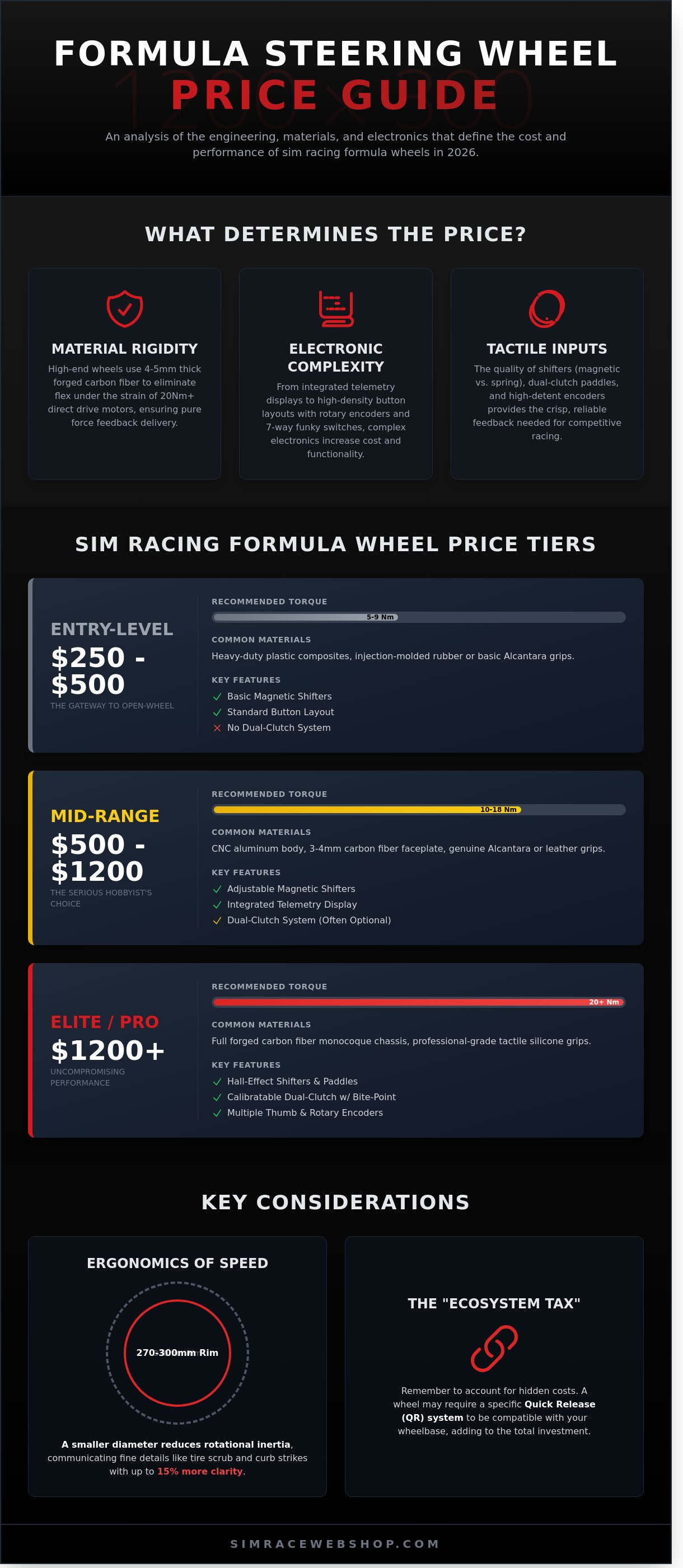
Une roue de type Formula est un étrier rectangulaire spécialisé, conçu pour répondre aux exigences de braquage élevé des courses de voitures à roues ouvertes. Contrairement à une jante ronde traditionnelle, ces unités sont conçues pour une rotation limitée, généralement entre 360 et 540 degrés. Cette conception permet d'obtenir un effet de levier et un contrôle maximum sans que le pilote n'ait jamais besoin de retirer ses mains des positions 9 et 3. Le prix des volants de Formule 1 dépend principalement de trois facteurs : la rigidité du matériau, la complexité électronique et la qualité des commandes tactiles. Les volants haut de gamme utilisent des plateaux en fibre de carbone de 4 à 5 mm d'épaisseur pour garantir l'absence de flexion lorsqu'ils sont associés à des moteurs à entraînement direct produisant un couple de 20 Nm ou plus.
La complexité de ces unités reflète la technologie des voitures de Formule 1, où chaque cadran et chaque interrupteur fournit des données essentielles au pilote. Alors qu'une jante GT standard peut coûter 300 euros, une roue Formula de qualité professionnelle commence souvent à 600 euros et peut dépasser 2 000 euros pour les répliques à l'échelle 1:1. Cet écart de prix s'explique par le fait que les jantes Formula nécessitent une ergonomie particulière et une disposition des boutons à haute densité, qui doivent rester accessibles tout en exerçant des forces G élevées dans un simulateur. En 2026, le marché aura connu une évolution significative, puisque même les roues de milieu de gamme sont désormais équipées de série d'écrans de télémétrie intégrés et de palettes de changement de vitesse magnétiques.
L'ergonomie de la vitesse
Le diamètre d'une roue Formula se situe généralement entre 270 et 300 mm. Cette taille compacte n'est pas seulement esthétique ; elle a un impact direct sur la fidélité de votre moteur à entraînement direct. Un diamètre plus petit réduit l'inertie de rotation, ce qui permet au moteur de communiquer des détails fins comme le frottement des pneus et les coups de trottoir avec 15 % de clarté en plus qu'une jante plus large de 330 mm. La conception de l'étrier est essentielle pour les simulations modernes de F1 et de GT3, car elle dégage la ligne de vision du pilote vers le tableau de bord tout en fournissant une plate-forme rigide pour les changements de direction rapides. La construction légère est l'objectif à atteindre, car chaque gramme enlevé au bord extérieur de la roue améliore la réactivité du système de retour de force.
Retour d'information tactile ou visuel
Il est facile de se laisser distraire par les 16,8 millions de couleurs RVB, mais les conducteurs professionnels privilégient le "clic" mécanique d'un levier de vitesse plutôt que l'aspect visuel. Le coût d'une roue dépend souvent de la qualité de ses composants mécaniques plutôt que de son éclairage. Les manettes haut de gamme utilisent des aimants en néodyme et des palettes en fibre de carbone pour fournir une force d'actionnement nette de 500 g qui empêche les doubles changements de vitesse accidentels. Les configurations professionnelles se concentrent sur les éléments tactiles suivants :
- Systèmes à double embrayage : Pédales analogiques avec étalonnage du point d'appui pour des départs de course parfaits.
- Codeurs rotatifs : Cadrans à haute densité qui ne sautent pas de position en cas de vibrations intenses.
- Encodeurs au pouce : Placés spécifiquement pour régler l'inclinaison des freins et le déploiement de l'ERS sans bouger les mains.
- Protection des boutons : Des bords surélevés autour des entrées critiques empêchent l'activation accidentelle du limiteur de profondeur.
Le seuil tactile représente le point technique précis où la résistance mécanique d'un commutateur fournit au conducteur une confirmation physique suffisante qu'un changement de vitesse s'est produit sans qu'il soit nécessaire de vérifier visuellement l'indicateur de vitesse. Lorsque vous calculez le prix d'un volant de Formule 1, vous payez pour la fiabilité de ces entrées sous le stress d'une course d'endurance de 24 heures ou d'un sprint de ligue à enjeux élevés.
Niveaux de prix des volants de Formule 1 de Sim Racing : De l'entrée à l'élite
Le prix des volants de Formule 1 est le reflet direct des tolérances techniques requises pour gérer les moteurs modernes à entraînement direct. Au fur et à mesure que vous montez dans l'échelle des prix, vous ne payez pas seulement pour l'esthétique ; vous investissez dans la rigidité du châssis et la complexité de l'électronique intégrée. Le marché se divise actuellement en trois niveaux d'investissement spécifiques qui déterminent le degré de précision de la colonne de direction. Chaque niveau représente un saut significatif en matière de retour tactile et de qualité de fabrication, conçu pour répondre aux exigences des différentes puissances de couple et des niveaux de compétence des conducteurs.
Le niveau d'entrée : La porte d'entrée de l'Open-Wheel Racing
Les jantes d'entrée de gamme, dont le prix se situe généralement entre 250 et 500 dollars, constituent le point de départ principal pour les passionnés qui s'éloignent des ensembles roue-pédale. Des marques comme Moza avec la roue KS ou les jantes d'entrée de gamme Fanatec ClubSport utilisent des composites plastiques résistants plutôt que des alliages métalliques coûteux. Vous trouverez généralement des leviers de vitesses magnétiques de base, sans réglage de la course, et des poignées en caoutchouc moulé par injection ou en Alcantara de base. Ces roues sont conçues pour des empattements produisant un couple de 5 à 9 Nm. Si vous montez une jante en plastique d'entrée de gamme sur un empattement de 20Nm, vous risquez de constater une flexion notable dans les virages à fort coefficient de gravité, ce qui perturbe le signal de retour de force.
- Matériaux : Plastiques renforcés de fibres de verre et poignées en caoutchouc.
- Connectivité : Broches de base ou systèmes sans fil propriétaires.
- Idéal pour : Les débutants utilisant le Moza R5 ou le Fanatec CSL DD.
Le milieu de gamme : La précision rencontre la fibre de carbone
Le passage à la fourchette de 500 à 1 200 dollars pour les passionnés introduit un changement significatif dans la construction de qualité professionnelle. Simagic et Ascher Racing ont placé la barre très haut en faisant des faces avant en fibre de carbone de 4 à 5 mm le standard de l'industrie pour les cycles de matériel 2026. Cette rigidité est essentielle pour traduire les vibrations à haute fréquence d'une base d'entraînement direct de 15Nm sans perdre d'informations à cause de la flexion du matériau. Vous avez également accès à des systèmes à double embrayage. Ceux-ci permettent un étalonnage précis du point d'appui, ce qui fait souvent la différence entre un départ arrêté parfait et un patinage sur la grille. Le retour tactile des boutons en aluminium usinés CNC et des interrupteurs tactiles offre un niveau de précision que les alternatives en plastique ne peuvent égaler.
Niveau Elite : Le cockpit Pro-Grade
Le niveau élite s'étend de 1 200 à plus de 3 000 dollars et représente le summum absolu de la technologie de simulation. À ce niveau, des marques comme Cube Controls et Simucube proposent un matériel qui fait le lien avec la technologie de la Formule 1 réelle en utilisant de l'aluminium de qualité aérospatiale et des fibres de carbone authentiques. Ces jantes sont souvent dotées d'unités d'affichage de données (DDU) intégrées avec des écrans tactiles haute résolution de 4,3 pouces qui fournissent des données télémétriques en temps réel. Les répliques authentiques, telles que le Ferrari SF1000 de Thrustmaster ou les modèles personnalisés de GSI, se vendent très cher car elles utilisent les mêmes commutateurs et encodeurs rotatifs que ceux que l'on trouve dans les véritables cockpits sanctionnés par la FIA. Lorsque vous analysez le prix d' un volant de Formule 1 à ce niveau, vous payez pour une transmission de données sans latence et la sensation tactile la plus authentique disponible dans le hobby.
Le choix du bon niveau dépend fortement de votre écosystème existant et de vos objectifs de performance sur la piste. Si vous êtes prêt à gagner des secondes sur vos temps au tour avec un meilleur matériel, vous pouvez explorer notre sélection de jantes de formule pour trouver la correspondance parfaite avec votre empattement.
Des caractéristiques haut de gamme qui justifient le prix élevé
Lorsque vous passez des périphériques d'entrée de gamme au matériel de qualité professionnelle, vous ne payez pas seulement pour le logo d'une marque. Vous investissez dans une ingénierie conçue pour supporter les forces violentes d'un moteur à entraînement direct de 25 Nm sans la moindre flexion. Une jante en plastique standard pourrait grincer ou se déformer sous l'effet d'un couple élevé ; un outil professionnel reste une extension rigide et silencieuse de la crémaillère de direction. Cette intégrité structurelle est la base de la cohérence. Si le volant fléchit, les détails du retour de force sont absorbés par le matériel au lieu d'être transmis à vos mains. Cette perte de fidélité peut vous coûter 0,1 à 0,2 seconde par secteur, simplement parce que vous n'avez pas senti les pneus arrière perdre de l'adhérence à temps.
La science des matériaux joue un rôle essentiel dans cet écart de performance. La fibre de carbone forgée est devenue l'étalon-or de l'industrie pour les jantes d'élite. Contrairement à la fibre de carbone tissée traditionnelle, qui utilise des feuilles superposées, les composites forgés utilisent des fibres de carbone hachées, pressées dans un moule sous une pression extrême. Ce processus crée un matériau aux propriétés isotropes, ce qui signifie qu'il est également résistant dans toutes les directions. Il permet aux fabricants de réduire la masse en rotation de la roue de 35 % par rapport à l'aluminium 6061. Une masse plus faible signifie moins d'inertie ; le moteur peut changer de direction plus rapidement, ce qui permet d'obtenir des textures de route plus nettes et plus authentiques. Si le prix élevé d' un volant de Formule 1 peut sembler décourageant, l'utilisation de matériaux de qualité aérospatiale garantit que la jante survivra à des milliers d'heures de course sous haute tension.
La qualité d'entrée est le dernier pilier de l'expérience haut de gamme. Les roues professionnelles ont abandonné les potentiomètres physiques qui s'usent avec le temps. Elles utilisent plutôt des capteurs à effet Hall pour suivre le mouvement des pagaies. Ces capteurs utilisent des aimants pour détecter la position, ce qui signifie qu'il n'y a aucun contact physique et aucune usure. Associée à des contrôleurs d'une résolution de 16 bits, la roue saisit chaque micro-ajustement que vous effectuez. C'est grâce à ce niveau de précision que les pilotes de simulateurs professionnels peuvent maintenir un angle de dérapage spécifique pendant toute la durée d'un virage, alors que les pilotes occasionnels se débattent avec des corrections oscillantes.
Manettes magnétiques et haptiques
Les dérailleurs à ressort sont souvent mous et perdent leur tension après quelques centaines de milliers de clics. Les roues Formula haut de gamme utilisent des modules de palettes magnétiques avec des aimants en néodyme pour offrir un engagement tactile et instantané. Ces modules ont une durée de vie de plus de 10 millions de cycles, ce qui garantit que la sensation de changement de vitesse au jour 1 000 est identique à celle du jour 1. Pour le cycle matériel 2026, le retour d'information haptique dans les palettes est la nouvelle référence. De petits actionneurs internes produisent un "bruit sourd" mécanique qui imite la pression hydraulique d'une véritable boîte de vitesses de F1. Le réglage de la portée des palettes est un autre élément essentiel ; rapprocher une palette de seulement 5 mm de la poignée peut réduire de manière significative la fatigue des mains pendant un relais d'endurance de 2,4 heures à Spa.
Télémétrie et DDU intégrés
L'intégration d'un écran LCD de 4,3 à 5 pouces dans la plaque du volant ajoute environ 200 à 350 dollars au prix total du volant de formule 1, mais l'avantage concurrentiel est mesurable. Ces écrans fonctionnent comme des unités d'affichage dédiées au tableau de bord (DDU). Grâce à SimHub ou à des écosystèmes propriétaires, vous pouvez afficher en direct la température de la carcasse des pneus, le delta de carburant et l'inclinaison des freins. Le fait d'avoir ces données dans votre vision périphérique signifie que vous n'avez pas besoin de détourner le regard de l'apex pour vérifier votre état. Dans un sport où une distraction de 0,5 seconde peut conduire à un freinage manqué, l'intégration de la télémétrie directement dans le volant est un outil de survie autant que de vitesse.
- Résistance isotrope : La fibre de carbone forgée supporte mieux les contraintes multidirectionnelles que les feuilles tissées.
- Capteurs à usure nulle : La technologie à effet Hall garantit une précision de 16 bits pendant toute la durée de vie de la roue.
- Latence réduite : Des microprocesseurs à haute vitesse à l'intérieur de la roue réduisent le délai entre la pression d'un bouton et l'action dans le jeu.
Coût total de possession : Dépenses cachées et compatibilité
Le calcul du prix d'un volant de Formule 1 ne se limite pas au chiffre figurant sur la page du produit. Les coureurs de simulateurs professionnels comprennent la "taxe sur l'écosystème" qui accompagne le matériel de haute performance. Lorsque vous achetez une jante d'élite, vous achetez souvent une infrastructure technique spécifique. Par exemple, une roue compatible avec le système sans fil Simucube offre un poste de pilotage sans encombrement, mais elle nécessite une base Simucube 2 pour fonctionner sans dongles supplémentaires. Cette intégration garantit une télémétrie sans latence, mais elle limite les possibilités de mise à niveau future, à moins que vous ne soyez prêt à acheter des récepteurs supplémentaires ou des kits de conversion. C'est un compromis entre l'immersion absolue et la flexibilité du matériel.
Les roulettes USB filaires offrent la plus grande flexibilité entre les différentes marques, mais elles présentent le risque d'une usure du câble. Un câble USB spiralé de haute qualité avec des connecteurs de qualité aéronautique peut coûter entre 40 et 70 dollars s'il doit être remplacé. Vous devez également tenir compte de la consommation électrique de votre jante. Les roues haut de gamme dotées d'écrans LCD haute résolution et de plus de 100 LED RVB nécessitent souvent un concentrateur USB alimenté pour maintenir une connexion stable, ce qui ajoute 50 $ supplémentaires à vos coûts d'installation initiaux. Chaque composant de votre chaîne de signaux doit être conçu avec précision pour supporter les vibrations constantes d'un moteur à entraînement direct de 25 Nm sans se déconnecter en cours de course.
Systèmes de fixation rapide et adaptateurs
La connexion mécanique entre la roue et la base est une source fréquente de coûts cachés. Moza et Simagic utilisent un système QR à roulements à billes basé sur les normes D1 du monde réel, ce qui permet un accouplement solide comme le roc. Cependant, si vous souhaitez monter une roue de marque comme GSI sur une base Fanatec, vous aurez besoin d'un moyeu Podium ou d'un adaptateur Leovinar spécialisé. Ces composants ajoutent généralement entre 60 et 160 dollars à votre facture totale. L'utilisation d'adaptateurs tiers peut augmenter votre budget matériel total de 15 % avant même que vous n'ayez fait un tour de piste. Vous devez vérifier les schémas de boulonnage, généralement 70 mm ou 50,8 mm, pour vous assurer que votre jante de 1 000 $ s'adapte bien à votre base de 1 000 $.
Entretien et longévité
C'est dans la durabilité à long terme que se révèle la véritable valeur d'un équipement haut de gamme. Les poignées en Alcantara offrent une sensation professionnelle, mais nécessitent un entretien constant avec des kits de nettoyage spécialisés à 20 dollars pour éviter le "glaçage" dû aux huiles de la peau. En revanche, les poignées en caoutchouc ou en silicone de haute qualité, comme celles de l'Ascher Racing F64, résistent à des années d'abus sans se dégrader. Choisir une roue avec des poignées remplaçables est une décision stratégique qui prolonge la durée de vie de votre investissement. Les marques haut de gamme comme Cube Controls ou Ascher conservent environ 80% de leur valeur de revente même après 24 mois d'utilisation intensive. Cette valeur résiduelle élevée justifie un prix initial plus élevé pour les volants de Formule 1, car le coût par heure de course reste faible par rapport aux alternatives en plastique d'entrée de gamme.
Trouver son Apex : la sélection de SimRaceWebshop
Choisir le bon matériel n'est pas seulement une question d'esthétique, c'est aussi une question de précision télémétrique et d'intégrité structurelle. Chez SimRaceWebshop, nous agissons en tant que conservateurs de qualité professionnelle, en vérifiant chaque pièce d'équipement pour s'assurer qu'elle survit aux rigueurs des systèmes d'entraînement direct à couple élevé. Nous nous concentrons sur l'intersection d'une rigidité sans compromis et d'une valeur marchande équitable. Lorsque vous évaluez le prix d'un volant de Formule 1, vous payez pour l'élimination de la flexion. Même un écart de 1,5 mm dans la jante peut étouffer le subtil retour haptique dont vous avez besoin pour rattraper une glissade à l'apex. Notre équipe teste ces unités avec un couple soutenu de 20Nm pour s'assurer qu'elles restent bien centrées pendant les courses les plus intenses.
En achetant auprès d'un spécialiste, vous obtenez du matériel qui comprend le réseau. Nous ne nous contentons pas de déplacer des boîtes, nous configurons des écosystèmes. Chaque roue que nous stockons est sélectionnée parce qu'elle offre un avantage tactile, qu'il s'agisse de palettes magnétiques avec un temps de réponse de 0,1 ms ou de boîtiers en aluminium usinés CNC qui protègent l'électronique interne. Votre installation doit être une extension transparente de votre intention, et notre sélection reflète cet engagement en faveur de l'ingénierie de précision. Nous comprenons que les besoins d'un pilote évoluent au fur et à mesure qu'il gagne des dixièmes sur ses records personnels, c'est pourquoi nous stockons des équipements qui grandissent avec votre carrière.
Meilleure valeur des roues de Formule 1 pour 2026
Pour 90 % des coureurs de simulation, le point idéal se situe dans le milieu de gamme, là où les performances rencontrent l'accessibilité. Moza et Simagic ont redéfini ce segment pour la saison 2026. La série Simagic FX, par exemple, offre un cadre renforcé en fibre de carbone de 290 mm qui supporte les bases à couple élevé sans le moindre gémissement. Vous pouvez explorer notre collection de volants Simagic pour trouver des modèles qui offrent une ergonomie de niveau professionnel à une fraction du coût des constructions personnalisées sur mesure. Ces volants représentent l'investissement le plus judicieux pour les conducteurs qui passent d'un équipement d'entrée de gamme à un autre, car ils offrent une clarté tactile supérieure de 40 % à celle des jantes en plastique standard.
Le nec plus ultra des gréements sans compromis
Les pilotes d'élite qui recherchent le summum du réalisme se tournent vers des marques comme Ascher Racing et Cube Controls. Ces fabricants utilisent des plateaux en fibre de carbone de 5 mm et des interrupteurs tactiles de qualité industrielle qui reproduisent les sensations d'un véritable cockpit. Vous pouvez acheter des volants de qualité professionnelle pour découvrir le summum de la technologie de simulation. Notre équipe d'assistance vous aide à les intégrer dans votre écosystème complet, en assurant la compatibilité avec vos systèmes QR et vos logiciels de télémétrie existants. Lorsque le prix d' un volant de formule 1 dépasse 1 200 $, vous n'achetez pas seulement un périphérique, vous investissez dans un instrument de précision conçu pour des performances sans latence.
Votre choix final doit correspondre à votre niveau de compétence actuel et à la puissance de couple maximale de votre empattement. Suivez ces conseils pour obtenir un équipement équilibré :
- Entrée de gamme (5-9Nm) : Privilégiez les roues légères comme la Moza KS pour maximiser la clarté du retour de force sans surcharger le moteur.
- Milieu de gamme (10-15Nm) : Privilégier les structures en aluminium ou en fibre de carbone pour éviter la flexion de l'arbre dans les virages à fort coefficient de gravité.
- Professionnel (20Nm+) : N'utilisez que des roues avec des plaques en fibre de carbone de 5mm+ et des attaches rapides de haute qualité pour garantir la sécurité et la fidélité du retour d'information.
Ne dépensez pas trop pour une jante si votre base n'est pas en mesure de communiquer les détails, mais n'essayez jamais d'utiliser une base haut de gamme avec une roue lourde en plastique. Tout est question d'équilibre, et nous sommes là pour vous aider à trouver l'équilibre parfait pour votre cockpit. Que vous soyez à la recherche d'un podium dans une course de ligue ou que vous souhaitiez simplement perfectionner votre ligne, la bonne roue est votre principal lien avec l'asphalte.
Assurez votre position sur la grille 2026
Investir dans une jante haut de gamme est plus qu'une question d'esthétique ; il s'agit des temps de réponse à la milliseconde requis pour la compétition d'élite. Les tendances actuelles du marché montrent que le prix des volants de formule 1 reflète le passage à une construction 100 % en fibre de carbone et à des écrans télémétriques intégrés de 4,3 pouces à rafraîchissement élevé. Que vous choisissiez un modèle pour passionnés à 599 dollars ou une réplique de qualité professionnelle à 3 200 dollars, vous investissez dans la compatibilité avec la transmission directe à 25 nm et dans la précision tactile des palettes magnétiques à double embrayage. Ces composants sont des outils essentiels conçus pour réduire de dixièmes votre record personnel à chaque sommet. Nous agissons comme votre conservateur de qualité professionnelle, en tant que revendeur agréé de Simucube, Moza et Simagic, afin de garantir que chaque pièce de l'équipement répond à des normes sans compromis. Notre équipe fournit une assistance technique experte pour l'intégration de rigs complexes, soutenue par une livraison mondiale sur tout le matériel de simulation de course haut de gamme. Il est temps de combler le fossé entre la simulation virtuelle et les performances réelles en sport automobile. Améliorez votre cockpit avec un volant Formula conçu avec précision et commencez à dominer la piste dès aujourd'hui.
Questions fréquemment posées
Combien dois-je dépenser pour une roue Formula par rapport à mon empattement ?
Vous devez viser un rapport de dépenses d'environ 1:1 ou 1:1,5 entre votre volant et votre base à entraînement direct. Si vous avez investi 1 000 dollars dans un moteur de 15 Nm, le fait de dépenser 600 à 900 dollars pour la jante garantit que le matériel peut supporter le couple sans fléchir. Le prix d' un volant de formule 1 haut de gamme reflète l'ingénierie nécessaire pour transmettre un retour de force haute fidélité directement au bout de vos doigts.
Les jantes moins chères utilisent souvent des structures internes en plastique qui absorbent 20 % des détails que vous êtes censé ressentir sur la surface de la piste. Les montages haut de gamme exigent un écosystème équilibré. N'étranglez pas un empattement de 1 500 dollars en utilisant une jante d'entrée de gamme de 200 dollars qui ne peut pas communiquer les vibrations subtiles d'un pneu qui perd de l'adhérence à l'apex.
Ai-je besoin d'un écran sur mon volant pour la F1 24/25/26 ?
Un écran intégré n'est pas indispensable, car 100 % des titres de F1 modernes proposent un HUD complet à l'écran. Cependant, un écran LCD de 4,3 ou 5 pouces placé sur votre volant améliore vos performances en plaçant la télémétrie vitale dans votre champ de vision naturel. Ce positionnement peut vous faire gagner 0,1 seconde sur votre temps de réaction lorsque vous gérez le déploiement de l'ERS ou que vous vérifiez la température des pneus pendant une fenêtre de ravitaillement.
La plupart des coureurs professionnels préfèrent un écran VoCore ou Nextion qui affiche plus de 20 points de données simultanément. Cela crée un environnement plus immersif dans le cockpit et vous permet de désactiver le HUD virtuel distrayant sur votre moniteur. Cette configuration augmente votre vision périphérique, ce qui est essentiel lorsque vous naviguez dans un départ encombré à Monza ou à Monaco.
Les jantes Formula coûteuses sont-elles compatibles avec la PlayStation ou la Xbox ?
La compatibilité dépend de la base de la roue plutôt que de la jante, mais 90 % des roues boutique Formula sont conçues exclusivement pour le PC via un câble USB dédié. Si vous courez sur une PlayStation 5 ou une Xbox Series X, vous devez rester dans l'écosystème de votre fabricant de base comme Fanatec ou Logitech. Ces marques incluent des puces de sécurité spécifiques dans leur matériel pour contourner les protocoles de verrouillage des consoles.
L'utilisation d'une roue tierce haut de gamme sur une console nécessite souvent un adaptateur de 400 $, ce qui peut entraîner un décalage de 10 ms. Il est généralement préférable d'acheter une jante adaptée à la console pour s'assurer que tous les boutons et encodeurs rotatifs fonctionnent correctement. Sur PC, vous avez la liberté de combiner n'importe quelle marque de roue avec n'importe quel moteur en utilisant des modèles de boulons standard de 70 mm.
Quelle est la différence entre un simple embrayage et un double embrayage sur une Formula wheel ?
Un embrayage simple agit comme une entrée binaire ou analogique standard, tandis qu'un système à double embrayage vous permet de définir un point d'appui précis pour des départs arrêtés plus rapides de 0,05 seconde. Dans une configuration à double embrayage, vous tirez les deux palettes sur la ligne de départ et en relâchez une lorsque les feux s'éteignent. L'embrayage passe alors instantanément à un engagement précalibré de 65 %, ce qui évite le patinage des roues et maximise la traction au démarrage.
Cet avantage technique change la donne dans les ligues compétitives où la course jusqu'au premier virage est déterminante. Vous pouvez ajuster le point d'impact à mi-course à l'aide d'un bouton rotatif pour tenir compte de l'usure des pneus ou des changements de charge de carburant. La plupart des jantes Formula de qualité professionnelle intègrent désormais cette fonction en standard pour les coureurs de simulateurs sérieux.
Pourquoi les roues en fibre de carbone sont-elles beaucoup plus chères que les roues en aluminium ?
Les roues en fibre de carbone sont plus chères car elles offrent un rapport résistance/poids supérieur de 30 % à celui de l'aluminium 6061. La réduction de la masse en rotation de 400 grammes ou plus permet au moteur à entraînement direct de réagir plus rapidement aux micro-vibrations et aux pics soudains de télémétrie. Lorsque vous analysez le prix d'un volant de formule 1, vous payez pour des plaques de carbone forgé de 5 mm d'épaisseur qui éliminent toute flexion mécanique sous un couple de 20 Nm.
Le processus de fabrication de la fibre de carbone est également beaucoup plus exigeant en termes de main-d'œuvre, car il nécessite des moules et des cycles de durcissement spécialisés. Ce matériau ne se contente pas d'avoir un aspect professionnel ; il constitue une plate-forme rigide pour les dérailleurs magnétiques et les rotatifs lestés. Il en résulte une connexion plus tactile et plus réactive avec la voiture virtuelle que l'aluminium ne peut tout simplement pas égaler dans la même catégorie de poids.
Puis-je utiliser un volant Formula pour les jeux de rallye ou de drift ?
Vous ne devriez pas utiliser une roue Formula pour le rallye ou le drift, car son diamètre de 270 à 300 mm et sa conception ouverte rendent les mouvements rapides d'une main à l'autre pratiquement impossibles. Tenter une rotation de 900 degrés avec une jante rectangulaire entraîne une perte de grip dans 70 % des transitions à grande vitesse. Les angles vifs d'une jante Formula peuvent également provoquer des blessures si la roue se détache lors d'une sortie de drift à couple élevé.
Pour ces disciplines, une jante ronde de 320 ou 330 mm est l'outil indispensable pour garder le contrôle de la voiture. Les roues Formula sont des instruments de précision conçus pour les petits mouvements à 360 degrés que l'on trouve dans les courses à roues ouvertes. Si vous aimez plusieurs genres, un système d'attache rapide est le meilleur moyen de passer d'une jante Formula à une roue ronde de rallye en moins de 10 secondes.
Qu'est-ce qu'une attache rapide et est-elle incluse dans le prix de la roue ?
L'attache rapide (QR) est l'accouplement mécanique qui relie votre roue à l'arbre du moteur, et elle est rarement incluse dans le prix de base d'une jante de boutique. La plupart des roues haut de gamme sont livrées avec un modèle de boulon standard de 70 mm, mais vous devrez dépenser entre 60 et 200 dollars supplémentaires pour un QR spécifique à la marque. Par exemple, les utilisateurs de Fanatec doivent acheter le système QR2, tandis que les propriétaires de Simucube ont besoin du montage SQR.
Il est essentiel de vérifier la description du produit avant d'acheter pour éviter les coûts cachés. Un QR de haute qualité élimine à 100 % les bruits de jeu ou de "clunking" dans les virages serrés. Investir dans un QR en métal massif garantit que le retour de force reste net et que les broches électriques ne se déconnectent pas pendant une longue période d'endurance.
Cela vaut-il la peine d'acheter une roue Formula haut de gamme d'occasion ?
L'achat d'une roue d'occasion est judicieux si le prix est inférieur de 30 à 40 % au prix de détail et si les manettes magnétiques ont encore un clic net et tactile. Le matériel haut de gamme de marques comme GSI ou Cube Controls est conçu pour durer des milliers d'heures, de sorte qu'une roue vieille de deux ans fonctionne souvent comme si elle était neuve. Demandez toujours une vidéo du connecteur 12 broches ou USB pour vous assurer qu'il n'y a pas de dommages physiques dus à un montage incorrect.
Vérifiez l'état des poignées en Alcantara ou en caoutchouc, car ce sont les seules pièces qui s'usent généralement après 500 heures d'utilisation. Si les poignées sont usées, vous pouvez souvent les remplacer pour environ 50 dollars. Une roue de 1 200 dollars bien entretenue conserve généralement 70 % de sa valeur, ce qui en fait un investissement relativement sûr pour les coureurs qui aiment améliorer leur poste de pilotage toutes les deux ou trois saisons.
 Assistant AI-winkel de la boutique en ligne Sim Race