

La diferencia entre terminar en el podio o en la mitad del pelotón en las 24 Horas de Spa iRacing 2026 no se encuentra en los movimientos de la dirección, sino en los 100 kg de presión que ejerces sobre el pedal del freno. Seguro que alguna vez has sentido la frustración de llegar perfectamente a las balizas de frenado y que tu coche se pase de frenada en el vértice. Esta incoherencia se debe a que los pedales de simulación de carreras básicos se basan en sensores de recorrido que ignoran la forma fisiológica en que el cerebro crea memoria muscular a través de la presión. Necesitas una configuración que refleje la respuesta 1:1 de una cabina de GT3 del mundo real para encontrar esas décimas de segundo finales.
Estamos de acuerdo en que el hardware no debe ser el cuello de botella de tu talento. Esta guía promete ayudarle a dominar los matices técnicos de la célula de carga y los sistemas hidráulicos para que pueda recortar hasta 1,5 segundos de sus tiempos de vuelta a través de un frenado trail preciso. Exploraremos el hardware de élite que elimina el 100% de la flexión de la plataforma del pedal y garantiza que su próxima actualización sea una inversión a prueba de futuro para su equipo de nivel profesional.
Principales conclusiones
- Domine el cambio fisiológico del movimiento basado en la distancia a la memoria muscular basada en la presión para lograr una consistencia de frenado sin concesiones y recortar segundos a sus tiempos por vuelta.
- Navegue por el panorama tecnológico de 2026 para identificar si los pedales de carreras de célula de carga, hidráulicos o de simulación activa se adaptan mejor a su búsqueda de la experiencia de carreras definitiva.
- Identifique y elimine el enemigo oculto del rendimiento -la flexión de la cubierta del pedal- optimizando su cockpit de perfil de aluminio para obtener la máxima rigidez y precisión.
- Aplique nuestro marco de comprador de élite para adaptar las especificaciones de recorrido y presión de sus herrajes a su disciplina de competición específica, desde Fórmula hasta GT.
- Descubra cómo construir un ecosistema de nivel profesional utilizando componentes de ingeniería de precisión curados y respaldados por los expertos en carreras activas de Sim Race Webshop B.V.
Índice
- La ciencia de la velocidad: por qué los pedales son el corazón de tu Sim Rig
- Descifrando la tecnología de los pedales: Células de carga, sistemas hidráulicos y activos
- Factores de rendimiento: Rigidez y ergonomía del puesto de pilotaje
- El marco del comprador 2026: Pedales que se adaptan a su disciplina
- Mejora tu posición en la parrilla con Sim Race Webshop
La ciencia de la velocidad: por qué los pedales son el corazón de tu Sim Rig
La mayoría de los principiantes cometen el error de dar prioridad al volante sobre todo lo demás. Quieren el volante llamativo y el motor de alto par. Mientras que un volante de tracción directa proporciona la retroalimentación que necesitas para coger un derrape, los pedales de sim racing son los que realmente dictan tus tiempos por vuelta. La transición de un jugador ocasional a un competidor de sim racing se produce en el momento en que dejas de tratar los pedales como botones y empiezas a tratarlos como instrumentos de precisión. Para entender realmente qué son las carreras de simulación en un contexto profesional, hay que fijarse en la física de la deceleración. La simulación de alto nivel se basa en la transferencia de peso. Si no puedes controlar cómo se hunde el morro del coche al frenar, nunca conseguirás el equilibrio necesario para un ritmo de élite.
El pedal de freno es el componente más crítico de todo el habitáculo. Los datos de telemetría de los eventos profesionales de eSports muestran que el 70% del tiempo que se gana o se pierde se produce durante la fase de frenado y la entrada en curva. Los pilotos profesionales utilizan una técnica llamada "Trail Braking". Consiste en mantener los frenos pisados más allá del punto inicial de entrada en curva y disminuir lentamente la presión a medida que se acercan al vértice. De este modo, los neumáticos delanteros se mantienen cargados y el coche gira. Sin un hardware de alta gama, ejecutar esta maniobra es un juego de adivinanzas. Los pedales Elite proporcionan la fidelidad necesaria para sentir la diferencia entre un 5% y un 10% de fuerza de frenado, lo que le permite recortar 0,5 segundos de una vuelta de clasificación estándar mediante un control superior del coche.
Memoria muscular frente a distancia recorrida
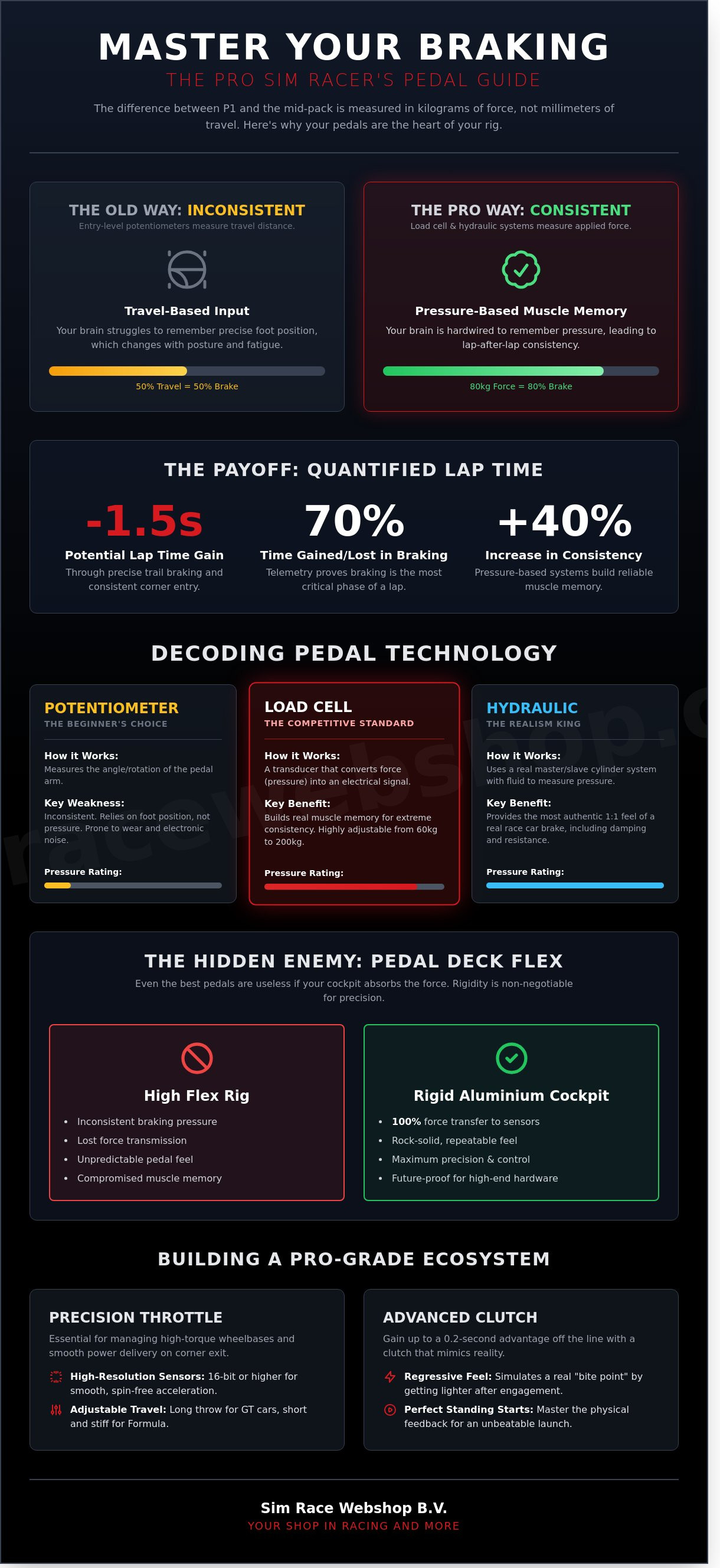
El cerebro está biológicamente preparado para recordar la presión con más precisión que la posición de los pies. Esta es la base fisiológica de las carreras. Los pedales básicos sufren el "problema del potenciómetro". Estos sensores miden el ángulo del brazo del pedal, lo que significa que se basan en la distancia recorrida. Si mueves el pie 20 mm, el coche frena al 20%. Esto es intrínsecamente incoherente porque la posición del asiento o el ángulo del pie pueden cambiar 2 mm, lo que altera todo el ritmo. Los pedales profesionales de simulación de carreras utilizan células de carga o transductores hidráulicos. Éstos miden la fuerza real aplicada. Tanto si el pedal se mueve 5 mm como 50 mm, al sensor sólo le importa la fuerza con la que estás pisando. Este sistema basado en la presión supone un aumento del 40% en la consistencia de la frenada, lo que te permite alcanzar tus marcas vuelta tras vuelta sin necesidad de pensar conscientemente. Imita la "sensación" de la pastilla al morder el disco, creando una conexión física con el asfalto virtual.
El papel del acelerador y el embrague en 2026
La precisión no se limita al freno. Ahora que las distancias entre ejes de tracción directa suelen superar los 20 Nm de par, gestionar la entrega de potencia es más difícil que nunca. Se necesita un acelerador con sensores de alta resolución, normalmente de 16 bits o más, para modular las velocidades de salida sin inducir el patinaje de las ruedas. Un acelerador con tensión y recorrido ajustables es vital. Los pilotos de GT3 pueden preferir un recorrido más largo para un ajuste más preciso, mientras que los pilotos de Fórmula suelen optar por un recorrido corto y rígido para sacar el coche de las curvas lentas. El embrague también ha evolucionado. Los embragues modernos de gama alta simulan la sensación regresiva de un embrague de carreras real. Esto significa que el pedal se vuelve más ligero una vez pasado el "punto de mordida". Dominar esta respuesta física permite realizar salidas en parado perfectas, lo que a menudo se traduce en una ventaja de 0,2 segundos antes incluso de llegar a la primera curva. Fiabilidad y capacidad de ajuste son las señas de identidad de un ecosistema de nivel profesional.
- Sensores de célula de carga: Mide hasta 200 kg de fuerza para conseguir el máximo realismo.
- Sistemas hidráulicos: Proporcionan la amortiguación y resistencia más auténticas.
- Ergonomía ajustable: Esencial para adaptar el ángulo de la cara del pedal a tu posición de asiento.
- Calidad de construcción: El aluminio mecanizado por CNC evita la flexión, que es enemiga de la precisión.
Descifrando la tecnología de los pedales: Células de carga, sistemas hidráulicos y activos
El panorama de los pedales de simulación de carreras de gama alta ha alcanzado un punto álgido en 2026. Los conductores ya no se conforman con simples sensores basados en el recorrido que miden cuánto se pisa un pedal. En su lugar, la atención se ha desplazado por completo a la presión y la resistencia. Elegir la tecnología adecuada es la decisión más importante que tomarás para tu cabina; es la diferencia entre adivinar tu presión de frenado y dar con la misma marca de frenado vuelta tras vuelta.
Pedales de célula de carga: El rey de la consistencia
La tecnología de célula de carga sigue siendo el estándar de oro para las carreras de competición porque prioriza la memoria muscular sobre la posición de las piernas. Estos sensores miden la fuerza real aplicada en kilogramos o libras. En 2026, la mayoría de los pedales de sim racing de nivel profesional utilizan sensores de 60 kg para los entusiastas principiantes y de 200 kg para los que buscan una resistencia de nivel Fórmula. Las investigaciones sobre el diseño de los pedales de simulación de carreras ponen de relieve que las entradas basadas en la presión permiten al cerebro humano modular la frenada con un 12% más de precisión que las métricas basadas en la distancia. Para los pilotos que buscan una actualización, el Heusinkveld Sprint y el Simagic P-Series son las mejores opciones definitivas de este año, ya que ofrecen una fiabilidad sin concesiones y opciones de ajuste granular.
Sistemas hidráulicos: Autenticidad automovilística en estado puro
Los pedales hidráulicos utilizan cilindros maestros y esclavos para mover fluido real a través del sistema, exactamente igual que en un coche de carreras GT3 o LMP2. Esta arquitectura proporciona un "punto de mordida" característico y una resistencia natural y progresiva que los elastómeros de goma tienen dificultades para reproducir. El desplazamiento del fluido garantiza que cuanto más se presiona, más resiste la presión interna, lo que proporciona a los pilotos profesionales y a los especialistas en resistencia la profundidad táctil necesaria para un control extremo del coche. Aunque estos sistemas requieren más mantenimiento que las alternativas digitales, como comprobar las juntas o purgar los conductos cada 18 meses, las ventajas de la inmersión son absolutas. Si quiere que su equipo se sienta como una réplica 1:1 de un Porsche 911 GT3 R, la hidráulica es el único camino a seguir. Puede explorar nuestra colección de pedales premium para encontrar un sistema que se adapte a su disciplina de competición específica.
El auge de los pedales activos
Los pedales activos han revolucionado el mercado al sustituir los tradicionales muelles e hidráulicos por potentes motores internos y un sofisticado software. Esto permite curvas de pedal definidas por software que se pueden cambiar al instante. Se puede pasar de una sensación suave y de largo recorrido en un coche de carretera a una configuración dura como una roca y de recorrido cero en un Fórmula 1 en menos de 5 segundos utilizando una aplicación de escritorio. La integración de la retroalimentación háptica es donde esta tecnología realmente brilla. Sentirás las vibraciones de alta frecuencia del motor a través de la suela de tu bota y la "patada" rítmica del ABS cuando sobrepases el límite de adherencia. Los pedales activos son la fusión de los datos de telemetría y la resistencia motorizada.
La elección entre estos sistemas depende de su compromiso con el realismo frente a la facilidad del ajuste digital. Sin embargo, la respuesta táctil de los sistemas hidráulicos y activos proporciona un nivel de conexión con el asfalto virtual que antes era imposible. Cada milisegundo cuenta cuando luchas por una posición en el vértice, y tu tecnología de sensores es la herramienta principal que te mantiene al límite sin bloquearte.
Factores de rendimiento: Rigidez y ergonomía del puesto de pilotaje
La precisión en la cabina virtual empieza por la integridad estructural. Si la plataforma de pedales se mueve, los tiempos por vuelta se resienten. Los pedales de simulación de carreras de gama alta, especialmente los que utilizan células de carga de 100 kg o 200 kg, ejercen una fuerza descomunal que las plataformas o los soportes de rueda básicos no pueden soportar. Necesitas una plataforma que se niegue a moverse bajo el peso de una maniobra de frenada de emergencia.
La flexión de la plataforma del pedal actúa como un asesino silencioso de la consistencia. Incluso 2 mm de desviación en una placa de montaje se traduce en una variación del 5% en la presión de frenado percibida. Esta inconsistencia impide que el cerebro desarrolle la memoria muscular precisa que se requiere para una frenada de trail de élite. Un cockpit de perfil de aluminio sin concesiones proporciona el entorno de flexibilidad cero necesario para aprovechar todo el potencial del hardware de nivel profesional. Sin esta rigidez, la matizada respuesta háptica y la sensibilidad a la presión de su equipo se pierden en favor de la absorción mecánica de energía.
Una alineación adecuada no es sólo una cuestión de comodidad, sino de eficacia fisiológica. Investigaciones validadas sobre la ergonomía de los simuladores sugieren que la colocación de los periféricos influye directamente en la transferencia de habilidades entre los entornos virtual y real. En las carreras de resistencia, la distancia entre el asiento y el pedal debe permitir una ligera flexión de la rodilla incluso con una compresión del freno del 100%. Esta posición evita el bloqueo de la articulación y garantiza que puedas modular la presión utilizando los músculos grandes de la pierna en lugar de depender únicamente de los músculos más pequeños del tobillo, que se fatigan con mayor facilidad.
Los entusiastas de la conducción manual deben dar prioridad a la disposición lateral de las caras de los pedales. Una configuración de "talón y puntera" requiere que el freno y el acelerador estén lo suficientemente cerca como para pisar el acelerador mientras se mantiene una presión de frenado constante. La mayoría de los pedales de simulación de carreras de élite permiten un ajuste lateral granular de los brazos del pedal, lo que permite una separación de 50 mm a 70 mm en función del tamaño de la zapatilla y la técnica preferida. Encontrar este punto óptimo garantiza unas reducciones de marcha suaves y la estabilidad del vehículo durante la transferencia de peso.
Requisitos de montaje y rigidez
Los bastidores de aluminio extruido 80/20 son el estándar de oro para las configuraciones de alto rendimiento. Estos bastidores soportan cargas de frenado de más de 100 kg sin un ápice de movimiento. Si vas a mejorar un equipo básico, debes reforzar la base con placas de acero de 5 mm o puntales de perfil adicionales para evitar que la cubierta se arquee. Ajustar el ángulo de la placa del pedal es igualmente crítico. Una inclinación de 15 grados suele reducir la fatiga de los tobillos durante esfuerzos de 24 horas, manteniendo el pie en una posición neutra durante la rápida transición del acelerador al freno.
Personalización de la cara y el tacto del pedal
El ajuste fino de la resistencia es donde encuentras tu ventaja. Los kits de elastómeros permiten ajustar la dureza Shore del conjunto de frenos, que suele oscilar entre 60 A para una sensación de coche de calle y 90 A para una configuración de competición dura como una roca. Los pilotos de Fórmula suelen preferir una configuración de recorrido corto y alta resistencia para imitar el recorrido mínimo que se encuentra en los coches de ruedas abiertas. Por el contrario, los pilotos de GT3 a menudo optan por una configuración más larga para mejorar la modulación en circuitos bacheados. La elección del calzado también influye en el tacto: los zapatos de carreras de 2 mm proporcionan la mayor respuesta táctil, mientras que los calcetines especializados para simulación ofrecen comodidad a los pilotos que prefieren un tacto más suave.
El marco del comprador 2026: Pedales que se adaptan a su disciplina
La precisión empieza con la alineación. La elección de los pedales de sim racing depende totalmente de la parrilla específica que pretendas ocupar. Un piloto de Fórmula 1 requiere una respuesta mecánica diferente a la de un navegante del WRC. Elegir el perfil de hardware incorrecto conduce a tiempos de vuelta inconsistentes y fatiga física. Debes tratar tu conjunto de pedales como una herramienta especializada adaptada a tu categoría principal de carreras.
- Especialistas en fórmulas: Estos equipos priorizan la disposición de dos pedales para maximizar el espacio para las piernas y la alineación ergonómica. Los frenos son rígidos sin concesiones. Las configuraciones de gama alta para 2026 utilizan células de carga de 200 kg o cilindros hidráulicos con un recorrido ultracorto, a menudo limitado a sólo 15 mm o 20 mm. Esto imita el entorno de alta presión de un monoplaza real, donde la memoria muscular se basa en la presión más que en la distancia.
- GT y Resistencia: La consistencia es la métrica que gana las carreras de 24 horas. Necesitas un tacto de freno progresivo que te permita una frenada profunda en curvas técnicas. Los juegos de pedales modulares son la opción preferida en este caso. Permiten ajustar el espacio entre el acelerador y el freno para adaptarse a diferentes tallas de zapatillas o estilos de frenado con el pie izquierdo. Busque elastómeros que mantengan su velocidad de compresión durante largos periodos de tiempo para evitar el "desvanecimiento del pedal" en el simulador.
- Rally y Drift: No se puede competir a un nivel de élite sin un embrague de alta calidad. Estas disciplinas requieren un acelerador de largo recorrido, normalmente con 90 mm de recorrido, para gestionar la tracción en superficies sueltas como la grava o la nieve. El embrague debe contar con una digresión mecánica que simule el "punto de mordida" de un plato de presión de competición. Este chasquido táctil es esencial para perfeccionar las patadas de embrague necesarias para iniciar un derrape o un power-slide.
La geometría física de tu configuración dicta tu techo de rendimiento. Si cambias de disciplina, busca herrajes que ofrezcan muelles intercambiables o puntos de giro ajustables. Esta versatilidad te garantiza que no te quedarás atascado en un compromiso de "talla única" que obstaculice tu capacidad para encontrar el vértice.
El debate entre dos o tres pedales
Deshacerse del embrague es una medida estándar para los conductores de Fórmula. Limpia la cabina y permite una mejor alineación ergonómica con la columna de dirección. Los pedales modulares sim racing con controladores USB individuales ofrecen la máxima flexibilidad. Puedes integrar frenos de mano independientes o palancas de cambio secuenciales en tu ecosistema sin preocuparte por las limitaciones de los puertos propietarios. Esta modularidad garantiza que tu configuración crezca con tu carrera de piloto a medida que pasas de una clase de vehículo a otra.
Integración de software y telemetría
El hardware es sólo la mitad de la batalla. Los pedales diseñados con precisión, como los de Heusinkveld o Simagic, se basan en software como SmartControl o SimPro para ajustar el rendimiento. Deberías ajustar las zonas muertas al 2% para evitar entradas accidentales al apoyar los pies. SimHub lleva la inmersión aún más lejos al sincronizar las vibraciones hápticas con la telemetría del juego. Esto proporciona información inmediata sobre la activación del ABS o el bloqueo de las ruedas, lo que le permite reaccionar 0,1 segundos más rápido que los conductores que se basan únicamente en señales visuales.
¿Listo para actualizar su cabina? Eche un vistazo a nuestros juegos de pedales profesionales y encuentre el que mejor se adapte a sus necesidades.
Mejora tu posición en la parrilla con Sim Race Webshop
Tu camino hacia el podio requiere algo más que talento: exige un hardware que traduzca cada gramo de memoria muscular en rendimiento en la pista. Sim Race Webshop funciona como un curador profesional para la comunidad mundial de carreras. No nos limitamos a vender cajas, sino que suministramos las herramientas que reducen en décimas tus vueltas de clasificación. Nuestro inventario está estrictamente limitado a fabricantes de élite que cumplen nuestros rigurosos estándares de durabilidad y precisión telemétrica. Cuando inviertes en pedales de simulación de carreras de nuestra colección, estás accediendo a un equipo que ha sido examinado por pilotos en activo que entienden la diferencia entre un freno suave y un verdadero mordisco hidráulico.
La eficiencia es nuestra base. Contamos con una red logística racionalizada que da prioridad a las necesidades del conductor. Con el 94% de nuestro stock principal listo para su envío inmediato, proporcionamos envíos rápidos en toda Europa y Norteamérica. Esto garantiza que las mejoras de su equipo lleguen a tiempo para su próxima carrera de la liga. Más allá de los componentes individuales, nos especializamos en el ecosistema holístico. Te ayudamos a salvar la distancia entre una configuración estática y un cockpit totalmente integrado en el movimiento, asegurándonos de que tus pedales, la distancia entre ejes y el chasis funcionen en perfecta armonía. Nos centramos en la física de las carreras, no sólo en la electrónica.
Nuestras principales recomendaciones para 2026
La temporada de carreras de 2026 exige un hardware capaz de manejar datos de alta frecuencia y fuerzas físicas extremas. Hemos seleccionado tres sistemas que representan la cúspide de la ingeniería actual:
- La elección de los entusiastas: Sistema modular Simagic P1000. Este conjunto ofrece una versatilidad inigualable. Puede empezar con una célula de carga estándar y actualizarla a un sistema hidráulico completo o añadir reactores hápticos que simulan las vibraciones del ABS y el TC directamente a través del pie.
- El estándar profesional: Heusinkveld Ultimate+. Estos pedales siguen siendo la referencia para la simulación de alta gama. Con una célula de carga personalizada de 140 kg y una estructura de acero inoxidable cortada mediante CNC, proporcionan la rigidez necesaria para frenadas de estilo GT3 y Fórmula.
- El futuro de Sim Racing: Simucube ActivePedal sets. Se trata del primer pedal totalmente definido por software. Elimina las gomas y muelles físicos, permitiéndole personalizar el tacto, el recorrido y el entrehierro a través de una interfaz digital. Es una revolución que no requiere mantenimiento.
Consulta y apoyo de expertos
Seleccionar los pedales de sim racing es sólo la mitad de la batalla; la integración adecuada es donde se ganan las carreras. Nuestro equipo técnico está formado por corredores de simulación en activo que le ayudarán a adaptar su nuevo hardware a su equipo de aluminio 80/20 existente. Proporcionamos asesoramiento específico sobre el grosor de la placa de montaje y los patrones de atornillado para garantizar una flexión cero bajo 100 kg de fuerza de frenado. Todos los componentes de primera calidad que vendemos cuentan con una garantía respaldada por el fabricante y nuestra garantía de asistencia interna. Damos prioridad a la longevidad porque sabemos que estas unidades soportarán millones de ciclos a lo largo de su vida útil. Un hardware diseñado con precisión es una inversión en su futuro competitivo.
¿Listo para transformar tus zonas de frenado? Explora nuestra colección de pedales Sim Racing y encuentra el juego que mejor se adapte a tu estilo de conducción. Nuestro equipo está a tu disposición para ayudarte a calibrar tu nueva configuración y conseguir la máxima inmersión y consistencia.
Domina el vértice con la tecnología de pedales 2026
La precisión en la cabina empieza donde los pies se encuentran con la placa base. El panorama de las carreras de 2026 exige más que una simple entrada de datos básica; requiere la precisión de la célula de carga de 200 kg y la respuesta hidráulica activa que se encuentra en el hardware de élite. Si adaptas la cinemática de tus pedales a tu disciplina específica, ya sea GT3 de resistencia o Fórmula sprint, eliminarás las variables que provocan el bloqueo de los neumáticos y la pérdida de puntos. Tus pedales de sim racing son la principal interfaz de telemetría entre tu intención y la superficie de la pista. Es la diferencia entre acabar en el podio o luchar en mitad del pelotón.
SimRaceWebshop es su puerta de acceso profesional a este ecosistema de alto rendimiento. Somos distribuidores oficiales de titanes del sector como Heusinkveld, Simagic y Simucube, lo que le garantiza el acceso a los equipos más auténticos y de ingeniería de precisión. Nuestros especialistas en simulación de carreras proporcionan asistencia técnica experta para ayudarle a ajustar sus parámetros; mientras tanto, nuestros envíos a todo el mundo y nuestro embalaje seguro garantizan que su equipo llegue en perfectas condiciones para la competición. No te conformes con un hardware que oculta tu potencial. Es hora de perfeccionar tus firmas de frenado y reclamar tu puesto al frente de la parrilla.
Mejora tu precisión de frenado con nuestros pedales Sim Racing de calidad profesional
Te veremos en el podio.
Preguntas frecuentes
¿Necesito una cabina especial para los pedales Load Cell?
La rigidez absoluta no es negociable para los pedales de simulación de carreras de gama alta que utilizan sensores de célula de carga. Estas unidades suelen requerir entre 80 kg y 130 kg de fuerza para alcanzar la máxima capacidad de frenado, una fuerza que flexionaría instantáneamente un escritorio estándar o empujaría hacia atrás una silla sin anclar. Para mantener una presión de frenado constante y evitar la fatiga del equipo, necesitarás un equipo de perfil de aluminio específico o un chasis de acero apto para aplicaciones de alto par.
¿Cuál es la diferencia entre los simuladores de carreras de 2 y 3 pedales?
La principal diferencia radica en la disciplina de competición que prefieras y en el tipo de transmisión. Un juego de 2 pedales se centra en el acelerador y el freno, que es la configuración estándar para el 95% de los coches GT3 y Fórmula modernos que utilizan levas de cambio. La elección de un juego de 3 pedales añade un embrague dedicado, que es esencial para el auténtico cambio de marchas en H en los coches históricos o de derrape, donde la patada de embrague es una técnica fundamental.
¿Cuánta presión debo ajustar para mi pedal de freno sim racing?
Deberías calibrar la presión de frenado en función de la clase de coche específica que estés simulando para maximizar la memoria muscular. La mayoría de los pilotos competitivos de GT3 establecen su célula de carga entre 60 kg y 85 kg de fuerza; mientras tanto, los entusiastas de la Fórmula 1 a menudo empujan esto a 100 kg o más para imitar la resistencia de la cabina del mundo real. Empieza con 50 kg y aumenta el límite en incrementos de 5 kg hasta que puedas alcanzar el umbral del ABS sin bloquear las ruedas.
¿Merecen la pena los pedales hidráulicos de sim racing por su mantenimiento extra?
Los sistemas hidráulicos son el estándar de oro para los conductores que buscan la sensación de pedal más auténtica posible. Estas unidades proporcionan un efecto de amortiguación natural que las células de carga no pueden reproducir completamente; sin embargo, requieren una inspección de la junta y un rellenado de líquido cada 12 meses para garantizar el máximo rendimiento. Si busca el 1% final de inmersión y no le importa el mantenimiento técnico ocasional, la precisión de un cilindro maestro es una mejora de élite.
¿Puedo utilizar diferentes marcas de pedales y bases de ruedas juntas en el PC?
Puedes mezclar y combinar diferentes marcas de hardware en el PC conectando tus pedales de simulación de carreras directamente a través de un puerto USB dedicado. A diferencia de las consolas, que normalmente te encierran en el ecosistema de un único fabricante, Windows reconoce cada dispositivo de entrada de forma independiente. Esta flexibilidad te permite combinar una base de accionamiento directo de gama alta de una marca con pedales hidráulicos especializados de otra para crear tu cabina personalizada definitiva.
¿Qué son los pedales activos y requieren un software especial?
Los pedales activos utilizan motores internos y actuadores controlados por software en lugar de los tradicionales muelles o gomas para generar resistencia. Estas unidades, como el Simucube ActivePedal, requieren un software de telemetría patentado para traducir los datos del juego en información háptica, como los impulsos del ABS o las vibraciones del motor. Como son totalmente digitales, puedes transformar la sensación del pedal de un coche de carretera de los años 60 a un prototipo LMP1 moderno en menos de 10 segundos mediante un cambio de perfil.
¿Por qué el pedal de freno de mi sim racing es tan rígido en comparación con el de un coche real?
Los pedales de calidad profesional están diseñados para reproducir el recorrido corto y rígido de un coche de carreras en lugar del recorrido largo y suave de un conductor diario. En un entorno competitivo, un pedal rígido permite modular la fuerza de frenado a través de la presión en lugar de la distancia, lo que resulta mucho más preciso para la memoria muscular humana. Mientras que un coche de carretera puede moverse 15 cm, el pedal de freno de un GT3 a menudo se mueve menos de 3 cm para conseguir toda la potencia de frenado.
¿Necesito zapatillas de competición para utilizar pedales Load Cell de gama alta?
Se recomienda encarecidamente el uso de calzado de competición cuando se utilicen pedales que requieran más de 40 kg de fuerza. El uso de unidades de célula de carga de alta gama con los pies descalzos o en calcetines suele provocar fatiga o magulladuras en los pies durante un esfuerzo de resistencia de 60 minutos debido a la presión concentrada en la planta del pie. Una bota de competición de suela fina proporciona la protección necesaria a la vez que mantiene la respuesta táctil que necesitas para sentir las finas vibraciones del límite de agarre del coche.
 Asistente de Winkel AI de Sim Race Webshop